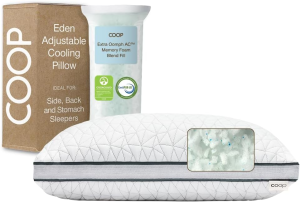








Back sleeping gets recommended constantly and then everybody does it on the wrong pillow. That’s the whole problem. Roughly a third of adults sleep on their back, and almost every pillow sold in a store is built for the side sleeper market, which means it’s too tall. You lie down, your chin gets pushed toward your chest, and you wake up with a stiff neck wondering why the position everyone calls the healthy one hurts.
Picking a pillow for back sleeping comes down to a much smaller gap than most people realize. Here’s what matters.
Loft is the whole game
Lie on your back on a flat surface with no pillow and slide your hand behind your neck. That little hollow, maybe an inch and a half deep on most people, is the entire space you’re trying to fill. Compare it to the gap a side sleeper has between their ear and the mattress, which can be four or five inches on a broad shouldered person. Same body, wildly different requirement.
In practice that puts most back sleepers between 3 and 5 inches of loft, measured after the pillow squashes under head weight rather than off the packaging. Manufacturers list uncompressed height and it’s basically fiction. A memory foam pillow advertised at 5 inches can flatten to 3 under an average head, which is fine, but a 5 inch latex pillow barely moves and will feel like a brick.
The self check is a photo. Have someone shoot you from the side while you’re lying down. Ears should line up roughly over your shoulders and your chin shouldn’t be tipped up or tucked down. If your chin is heading toward your sternum, the pillow is too tall, and no amount of getting used to it will fix that.
Fill types, ranked for back sleeping
Shredded memory foam is the safest starting point, mostly because you can unzip it and pull handfuls out. Back sleepers almost always need to remove fill rather than add it, and a pillow you can tune beats a pillow you have to hope about. It does sleep a bit warm and it needs fluffing every few days or it packs into lumps.
Solid memory foam holds a set height, which is nice if you’ve already figured out your number and terrible if you haven’t. Once it’s too tall it’s too tall forever. Latex behaves similarly but bounces back faster and runs cooler, though it’s heavy and pricier. If heat is your issue more than height, our memory foam vs latex comparison gets into which one actually breathes better.
Down and down alternative flatten too much for a lot of back sleepers, which sounds like a good thing given everything above, but they flatten unevenly and leave your head resting on the mattress by 3am. Skip them unless you already know you like a nearly flat pillow.
Contour pillows: back sleepers are the one group they suit
Cervical contour pillows get sold to everyone and really only make sense here. The shape is a dip in the middle for your skull with a raised ridge along the lower edge that tucks into the neck hollow. On your back that geometry is genuinely correct. On your side it’s a fight.
Two things to watch. First, contour pillows come in a couple of heights and the difference between them is enormous, so measure your neck gap before ordering rather than guessing. Second, if you’re a combination sleeper who rolls, the ridge that supports your neck on your back turns into a lump under your ear at 2am. Combination sleepers are better off with adjustable shredded fill.
The stuff people forget
Heat matters more on your back than on your side, because a bigger surface area of your head and neck stays pressed into the pillow all night with less air moving through. Cooling covers help some. Fill type helps more. There’s a full rundown in our cooling pillows roundup if you run hot.
Snoring is worth separating out too. A lot of back sleepers stack pillows trying to breathe better and end up kinking the neck forward, which narrows the airway instead of opening it. Raising the whole torso on a gentle wedge is the version that works. A taller pillow is not.
And if you split the night between your back and your side, buy for the side position and adjust down. It’s much easier to remove fill from an adjustable pillow than to add support to one that’s too flat. The side sleeper pillow guide covers that end of it.
Quick checklist before you buy
- Measure the hollow behind your neck lying flat. That’s your target, not the pillow’s listed height.
- Aim for 3 to 5 inches compressed, and treat anything advertised above 6 as a side sleeper pillow.
- Choose adjustable fill if you roll onto your side at all during the night.
- Check the return window. Most pillows need about a week before you can judge them fairly, and plenty of brands only give you 30 days.
One last thing, and it’s the one people push back on: if you’ve been on a too tall pillow for years, a correct one will feel wrong for the first few nights. Your neck has adapted. Give it a week before deciding, but not a month, because if it still hurts after a week its the wrong pillow and you should send it back.