






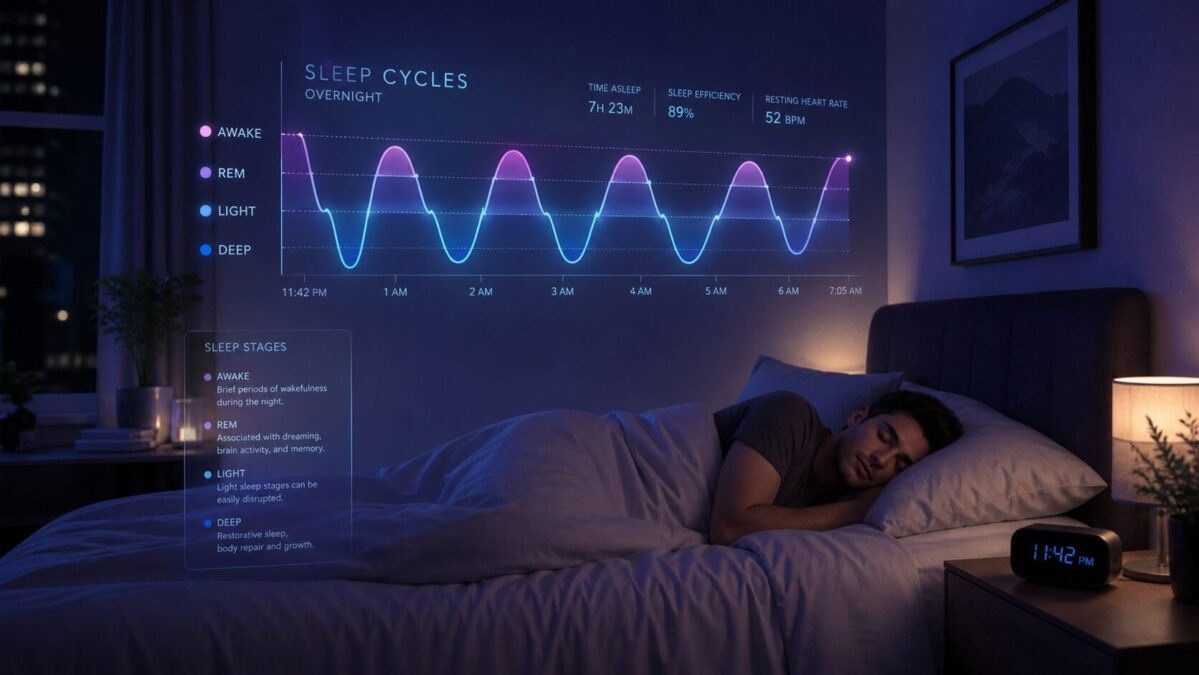
Sleep isn’t one thing. It’s four (or five, depending on how you count) different states your brain cycles through every night. Each does something different and each one matters. Here’s a clean explanation of what actually happens between lights-out and waking up.
The two big categories
All sleep splits into two: NREM (non-REM) and REM. NREM is “deep” sleep, REM is when you dream most vividly. They alternate in cycles of roughly 90 minutes throughout the night.
Stage 1 – “Drifting off”
The lightest sleep. 5-10 minutes long. You’re easy to wake. Heart rate slows, eye movement slows, muscles start to relax. If you’ve ever felt yourself “falling” and jerked awake, that’s a hypnic jerk during stage 1.
What it does: Transitions you from awake to actually sleeping. Light sleep, easy to lose if disturbed.
Stage 2 – “Light sleep”
About 50 percent of total sleep time. Body temperature drops further. Brain produces “sleep spindles” (short bursts of activity) that may be involved in memory consolidation. Heart rate and breathing become regular.
What it does: The bulk of your sleep is here. It’s where short-term memory becomes longer-term, where your brain processes the day’s information.
Stage 3 – “Deep sleep” (or slow-wave sleep)
The hardest stage to wake from. Brain produces slow delta waves. Body temperature, heart rate, and breathing all hit their lowest points. Growth hormone is released. Tissue repair happens here.
What it does: Physical recovery. Immune system function. The reason you feel “rested” is largely about how much stage 3 you got. Most stage 3 happens in the first half of the night.
REM – “Dream sleep”
About 20-25 percent of total sleep, mostly in the second half of the night. Eyes move rapidly behind closed lids (hence “rapid eye movement”). Brain activity looks similar to being awake on EEG. Body becomes temporarily paralyzed (sleep paralysis is when this paralysis hangs around as you wake).
What it does: Emotional processing, creativity, complex memory consolidation. Cutting REM sleep short reliably impairs mood and problem-solving the next day.
How a typical night plays out
Hour 1: Stages 1-2-3-2-1. First REM is brief.
Hour 2-3: More stage 3. Your “deep sleep” deposit happens here.
Hour 4-5: Stage 3 fades. REM cycles get longer.
Hour 6-7: Mostly stages 1-2 and REM. Your last big REM cycle is just before you wake up. This is why dreams are vivid right before alarm.
Why this matters for sleep quality
It’s not just hours of sleep. It’s hours of the right kind of sleep. Cutting your sleep short by 2 hours doesn’t lose 2 hours of generic sleep. It selectively eats your REM, which does the most damage to mood and cognition.
What hurts each stage
- Alcohol cuts REM
- THC cuts REM (which is why heavy users have intense dreams when they stop)
- Anxiety reduces stage 3
- Sleep deprivation eats both, but rebounds are uneven (REM rebound is bigger)
What helps each stage
- Consistent schedule helps stage 3
- Cool room helps stage 3
- Reasonable bedtime (not too late) helps you get adequate REM cycles in the second half
- Avoiding alcohol within 3 hours of bed
- Daylight exposure during the day, especially morning
You might also like:
Browse all Sleep Science & Tips >
Disclosure: Some links in this article are affiliate links. We may earn a commission at no extra cost to you.