






What You Need to Know
Lying awake staring at the ceiling is one of the most frustrating experiences. Whether you’re dealing with racing thoughts, restlessness, or just can’t seem to wind down, these research-backed strategies can help you fall asleep faster, starting tonight.
Developed to help soldiers fall asleep in under 2 minutes, this technique involves systematically relaxing every muscle from your face down to your toes, clearing your mind with calming visualization, and repeating “don’t think” for 10 seconds. With practice, 96% of people who try it can fall asleep within 120 seconds.
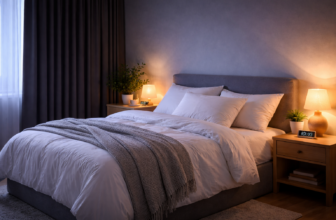
Your core body temperature needs to drop about 2-3°F to initiate sleep. Research published in the Journal of Physiological Anthropology shows that a cool room (65-68°F / 18-20°C) facilitates this natural temperature drop, helping you fall asleep faster and spend more time in restorative deep sleep.
Inhale through your nose for 4 seconds, hold for 7 seconds, exhale through your mouth for 8 seconds. This activates your parasympathetic nervous system, slowing your heart rate and signaling your body that it’s safe to sleep. Repeat 3-4 cycles.
Blue light from screens suppresses melatonin production by up to 50%. Use blue-light blocking glasses, enable night mode on devices, or better yet, switch to a book or podcast in the final two hours before bed.
Pick a random letter and think of words starting with that letter, visualizing each one. “B”, beach, banana, butterfly, boat. This prevents your mind from latching onto anxious thoughts while being boring enough to lull you to sleep.
What To Do When None Of Them Work
Every list like this assumes you’re doing something wrong that can be corrected in one night. Sometimes thats true. Sometimes you’ve done all seven, you’re lying there at 1am with a cool room and a clear head, and nothing is happening.
The move at that point is to get up. Twenty minutes awake is the usual threshold, though nobody should be watching a clock, so go by feel. Leave the bedroom, sit somewhere dim, read something boring on paper. Go back when you feel heavy. This is the core of stimulus control therapy and its one of the few things with strong clinical backing, because staying in bed frustrated teaches your brain that the bed is where you lie awake worrying.
The Ones Worth Ranking Higher
If you only ever do two things from a list like this, make them a fixed wake time and morning daylight. Wake time anchors the whole rhythm and its the lever most people never pull, because they focus on bedtime instead. Bedtime follows wake time, not the other way round. Getting outside within an hour of waking, even on a grey day, does more for tonight’s sleep than anything you do at 10pm.
The military method and 4-7-8 breathing both work by giving your attention somewhere to go. That’s genuinely useful for racing thoughts and does very little for anything else, so dont be surprised if they do nothing on a night when you’re just not tired yet.
When It Stops Being A Habit Problem
Three nights a week for three months or more and you’re in insomnia territory, which is a treatable condition and not a discipline failure. CBT-I is the first line treatment and it beats sleeping pills in the long run. Ask a doctor about it rather than working through another checklist.
For everything upstream of bedtime, the sleep environment guide covers the room itself, and the full hygiene checklist goes wider than seven tips.
Final Verdict
Spend 5 minutes writing down everything on your mind, tasks, worries, ideas. A Baylor University study found that people who wrote to-do lists before bed fell asleep 9 minutes faster than those who wrote about completed activities. Getting thoughts out of your head and onto paper frees your mind to rest.
You might also like:
- Building the Perfect Sleep Environment: A Room-by-Room Buyer’s Guide
- The Science of Sleep Cycles: Why You Wake Up Tired Even After 8 Hours
- Sleep Tracker Buyer’s Guide: Rings, Pads, and Watches Compared for 2026